Full-Funnel Technical Content Strategy
A structured framework for planning TOFU, MOFU, and BOFU content aligned to developer intent, product maturity, and business goals.
Technical content is no longer just educational collateral. In developer ecosystems for cloud and AI platforms, content directly impacts product discovery, evaluation, adoption, and long-term retention. Developers don’t respond to ads. They respond to clear explanations, transparent comparisons, and production-ready documentation that reduces risk and accelerates implementation.
A full-funnel technical content strategy ensures that content is intentionally designed to support:
- Developer search intent
- Product maturity and feature depth
- Business growth objectives
- Activation and expansion goals
Rather than producing isolated articles, this approach builds a cohesive content system that moves developers from awareness to implementation with clarity and confidence.
Why full-funnel strategy matters for developer platforms
Developers do not follow linear marketing journeys. They:
- Search for specific technical problems
- Compare architectural tradeoffs
- Evaluate pricing and scalability
- Validate documentation depth
- Assess production readiness
If content only addresses awareness-level questions, it attracts traffic but fails to convert.
If content only focuses on product features, it lacks discoverability.
A full-funnel strategy bridges this gap by aligning technical depth with user intent at every stage.
What is the funnel in a technical context
While marketing categorizes the funnel as TOFU (Top of the funnel), MOFU (Middle of the funnel), and BOFU (Bottom of the funnel), technical writing requires a more nuanced interpretation.
TOFU – Awareness & education
Developer mindset:
“I’m trying to understand a concept or solve a problem.”
Content objectives:
- Define core technical concepts
- Explain architectural patterns
- Introduce emerging technologies
- Provide neutral comparisons
Examples:
- What is Kubernetes?
- What is MLOps?
- GPU vs CPU for AI workloads
- PaaS vs IaaS explained
Strategic impact:
- Captures organic traffic
- Builds domain authority
- Establishes technical credibility
- Feeds the top of the acquisition pipeline
At this stage, the content should be educational, vendor-neutral in tone, and technically accurate.
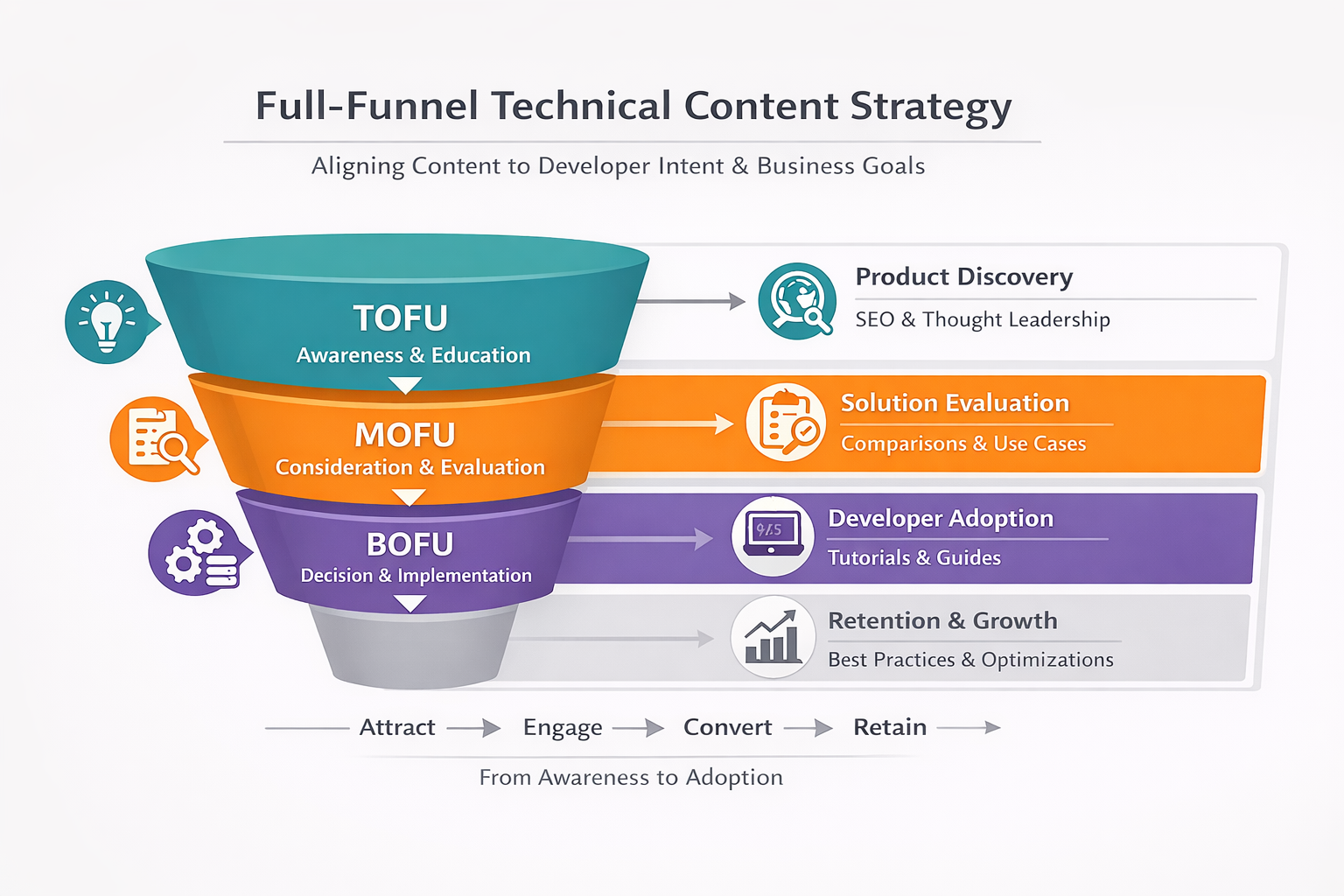
MOFU – Consideration & evaluation
Developer mindset:
“I understand the concept. Now I need to evaluate options.”
Content objectives:
- Compare platforms
- Explain implementation paths
- Break down pricing models
- Highlight operational tradeoffs
- Showcase architectural examples
Examples:
- DigitalOcean vs Heroku
- How to deploy a Streamlit app on App Platform
- Managed Kubernetes vs self-managed clusters
- Cost breakdown for GPU workloads
Strategic impact:
- Reduces decision friction
- Positions product strengths clearly
- Builds trust through transparency
- Moves developers closer to trial or signup
This stage requires balance. It must be persuasive without becoming promotional. Technical depth becomes critical here.
BOFU – Decision & technical validation
Developer mindset:
“I’m close to implementing. Show me how this works in production.”
Content objectives:
- Step-by-step implementation guides
- Migration playbooks
- Performance benchmarks
- Architecture diagrams
- Security and compliance breakdowns
Examples:
- Migrate from Heroku to App Platform in 2 days
- Deploy AI inference with GPU Droplets
- Production-ready Kubernetes cluster setup
- High-availability database configuration
Strategic impact:
- Drives activation
- Accelerates time to value
- Builds confidence in scalability
- Supports sales and solution architecture teams
BOFU content often has lower traffic but higher conversion impact. It is where technical writing directly influences revenue.
Aligning content to product maturity
A senior-level content strategy also considers where the product sits in its lifecycle.
| Product stage | Content focus |
|---|---|
| Early Feature Launch | Educational + use-case-driven content |
| Growth Stage | Comparisons + performance validation |
| Mature Platform | Advanced architecture + optimization guides |
| Enterprise Expansion | Compliance, governance, cost control content |
Content must evolve as the platform evolves.
For example:
- A newly launched AI inference feature needs foundational education.
- A mature Kubernetes product needs scaling and cost-optimization guides.
This alignment prevents content stagnation.
Mapping content to business goals
Technical content should support measurable outcomes.
Mapping Content to Business Goals
Technical content should support measurable outcomes.
| Funnel stage | Primary goal | Business impact | Sample tools | How to measure impact |
|---|---|---|---|---|
| TOFU | Traffic & Authority | Organic growth | Google Search Console, Ahrefs, SEMrush, GA4 | Organic traffic growth, keyword rankings, impressions, click-through rate (CTR), average engagement time |
| MOFU | Engagement & Evaluation | Trial consideration | GA4, Hotjar, HubSpot, Segment | Product page click-through rate, comparison page engagement depth, demo/trial signups, assisted conversions |
| BOFU | Activation & Adoption | Revenue & expansion | Product analytics tools (Mixpanel, Amplitude), CRM dashboards, internal BI tools | Activation rate, deployment completion rate, feature adoption, upgrade rate, customer expansion metrics |
Note: The tools listed above are illustrative examples. Many analytics, CRM, and product measurement platforms are available. Teams should select tools based on organizational maturity, existing tech stack, and measurement goals.
A strong strategy defines KPIs per stage:
- TOFU → Organic rankings, impressions, engagement depth
- MOFU → Click-through to product pages, trial signups
- BOFU → Activation rate, deployment completion, feature adoption
Without this alignment, content becomes activity rather than impact.
The role of technical depth
One common mistake in funnel strategy is reducing technical depth at upper stages. Business owners expect clarity and not oversimplification.
A senior technical content strategy:
- Explains concepts without dilution
- Uses diagrams where appropriate
- Balances clarity with accuracy
- Maintains consistent technical voice
Depth builds credibility. Credibility builds trust. Trust drives adoption.
Building a cohesive content system
A full-funnel strategy is not about isolated articles. It is about structured pathways.
For example:
- What is MLOps?
- MLOps tools comparison
- Deploying ML pipelines on Kubernetes
- Running GPU workloads with managed Kubernetes
Each article connects to the next, guiding developers naturally through increasing depth.
Internal linking, topic clustering, and architectural continuity are critical.
Common pitfalls to avoid
- Writing only awareness content with no conversion path
- Over-optimizing for SEO at the cost of clarity
- Treating comparison articles as sales pages
- Ignoring performance and cost transparency
- Failing to update content as product capabilities evolve
Senior technical writers operate at the intersection of clarity, strategy, and growth—not just word count.
How one concept transitions across TOFU, MOFU, and BOFU
A strong full-funnel strategy expands a single concept across increasing levels of depth and intent. Below is an example using GPU for AI workloads.
| Funnel Stage | Example article | Focus | Strategic goal |
|---|---|---|---|
| TOFU (Awareness) | What Is a GPU? The Engine Behind AI Computing | Define what a GPU is, how it differs from a CPU, and why it matters for AI and machine learning. Introduce core use cases like training and inference. | Capture educational search intent, build foundational understanding, and establish domain authority. |
| MOFU (Evaluation) | CPU vs GPU for AI Inference: Performance and Cost Comparison | Compare performance benchmarks, cost tradeoffs, workload suitability, and scaling considerations. Help developers evaluate infrastructure choices. | Reduce technical uncertainty and support informed decision-making. |
| BOFU (Implementation) | Deploying AI Inference on GPU Instances: Production-Ready Setup | Provide step-by-step deployment guidance, instance selection advice, scaling strategies, monitoring setup, and cost optimization tips. | Drive activation, accelerate time to value, and validate production readiness. |
Instead of creating disconnected articles, this approach builds a structured pathway that guides developers from curiosity to deployment.
A full-funnel technical content strategy transforms content from documentation support into a growth engine.
It ensures:
- Developers discover you
- Developers understand you
- Developers trust you
- Developers build with you
For cloud and AI platforms, where complexity is high and competition is intense, structured content strategy is not optional—it is foundational.
When technical writing aligns with developer intent and business outcomes, content becomes infrastructure.